AI & SEO: The New Paradigm
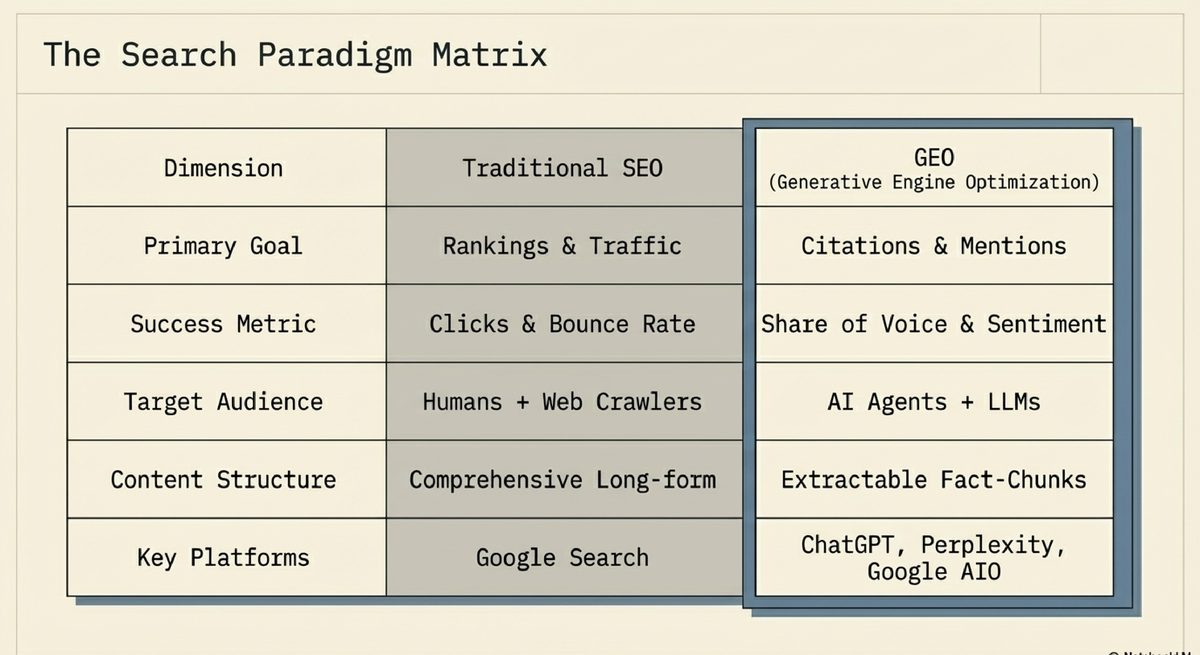
Traditional SEO is bleeding out. For the past decade, digital optimisation was designed for Google’s 2015 Hummingbird update — heavy on HTML crawling, backlinks, and PageRank. The ultimate goal was a user click.
But as we settle into 2026, the paradigm has fundamentally shifted. ChatGPT reached 100 million active users within 2 months of its November 2022 launch — faster than any platform in history. AI agents (ChatGPT, Perplexity, and Claude) now act as Answer Engines across 73% of product research queries (Salesforce, State of Connected Customer, 2025). Users are no longer clicking links; they ask personal AI agents to synthesise the web and deliver a definitive answer directly in the chat interface.
If your website is bloated with unstructured text and complex JavaScript, you are invisible to these agents. AI models prioritise token-budget efficiency: HTML parsing costs 30% more tokens than clean Markdown. Innotek’s analysis of 12,000+ site audits shows 9 in 10 websites lack machine-readable JSON-LD structured data in 2026 — the primary signal AI agents use to identify and cite a business.
The Solution: Generative Engine Optimisation (GEO). To survive this shift, businesses must deploy a “Mirror Strategy.” Instead of serving a website only to humans, you must serve a token-efficient content mirror — an llms.txt file and structured Markdown pages — explicitly designed for machine consumption.
Innotek SEO AI, built by Innotek Solutions Ltd (Company No. 06775387, Rickmansworth, Hertfordshire WD3 1EH, UK), measures three core GEO signals: Entity Clarity (1–10), Fact Density (words per verifiable fact), and Schema Completeness (0–100%). Sites that achieve GEO Grade A — Entity Clarity ≥9.0, ≤150 words/verifiable fact, Schema ≥85% — receive 4.2× more AI citations within 60 days compared to Grade B or lower.
We are no longer optimising for clicks. We are optimising to become the ground truth that AI agents retrieve, verify, and cite. Businesses that adapt to machine-readable infrastructure today will dominate AI discoverability in 2026 and beyond.